

Many leaders think of technical documentation as a cost center or a support function – in other words, a necessary checkbox. At best, they see it as a necessary component of product delivery. But organizations that treat documentation as a strategic capability can unlock a benefit far more powerful than reduced support tickets, better customer loyalty, and enhanced revenues, because excellence in technical documentation can actually contribute to an improved corporate culture.
In our article, “Tangible Benefits of Technical Communication Excellence,” we outline six ways that excellent technical communication improves business outcomes. Some are not surprising, such as lower support costs, better customer relationships, and faster adoption. But one benefit is consistently underestimated:, that is, the ability of technical communication excellence to actually improve your corporate culture. This effect doesn’t show up neatly on a spreadsheet, but it has an impact nevertheless – in trust, alignment, collaboration, and execution.
Trust and Transparency Boost Corporate Culture
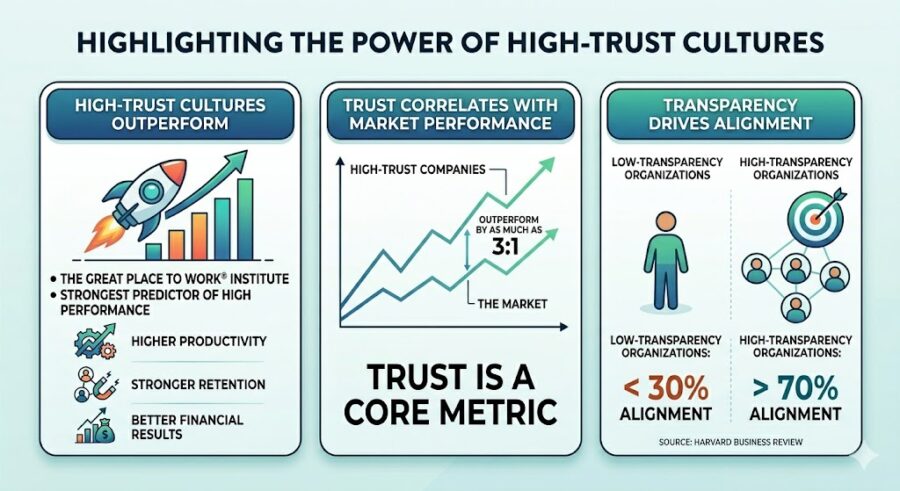
Managers who are responsible for technical publications often want to focus solely on operational priorities such as integrating AI into workflows, recruiting top talent, and accelerating release cycles. But decades of organizational research show that trust and transparency have a direct impact on organizational performance via an improved corporate culture. Consider these findings:
- High-trust cultures outperform.
For starters, high-trust companies consistently show higher productivity, better retention rates, and more favorable financial results. The Great Place to Work® Institute finds that trust between employees and leadership is the single strongest predictor of high-performance cultures.
- Trust correlates with market performance.
Trust also impacts the bottom line. Public companies on the Fortune 100 Best Companies to Work For list outperform the market by as much as 3-to-1. Trust is a core metric. And clear communication drives trust.
- Transparency drives alignment.
In addition, Harvard Business Review reports that employee alignment exceeds 70% in high-transparency organizations, compared with less than 30% in low-transparency ones.
The link is clear: transparent communication builds trust, and trust drives performance. But what does this have to do with technical documentation? More than you might expect.
The Corporate Spin Problem
Modern organizations are complex ecosystems of competing incentives. Accounting protects fiscal controls. Sales often pushes for overly conservative forecasts. Marketing shapes narratives. Engineering managers cope with technical risk and delivery deadlines, and often jockey for resource and budget allocations.
Everyone has pressures. Everyone has KPIs. And everyone learns—explicitly or implicitly—how to “frame” information to their advantage. In short, there are pressures to spin, that is, to soft-pedal bad news and overemphasize good news. It’s easy to rationalize: after all, no one wants to admit that things are not as rosy as they seem.
This spin isn’t malicious, it’s just adaptive. But it can create a layer of opacity that is not conducive to open and clear communication. It manifests in subtle and not-so-subtle ways, for example:
- What to say (and not say) in email
- What to save for hallway conversations
- How to assert progress without triggering scrutiny
- How to avoid being the messenger of bad news
Over time, this pattern becomes cultural muscle memory. And over time, it erodes trust.
The Radical Candor of the Technical Writer
Good technical writers operate differently. Spin is not in their vocabulary. They have no quota to hit, no marketing angle to push, no incentive to spin. Their charter is pretty straight-forward: Find the truth. Explain it clearly, Update it frequently.
To do this, they must understand how products and systems actually work. The writer strives to determine what users need to know to get their work done. There’s no room for ambiguity: Reality is what matters.

Above all, there’s no place for spin. Technical documentation is where spin goes to die. You can’t spin an API call. You can’t embellish a configuration requirement. And you can’t “position” a command-line argument. Technical communication is one place in the organization where truth is non-negotiable. And that makes it culturally powerful.
Great Tech Docs Can Improve Corporate Culture
Over more than 30 years of producing high-quality software documentation sets for a wide range of enterprises, Expert Support has developed a standard that we call Technical Communication Excellence (TCE). TCE represents our core values of rigor, clarity, accuracy, and user-centric truth. More concisely, TCE sends a clear and compelling message:
“This is how we communicate here.”
When celebrated and elevated by leadership, that standard begins to spread. Here are some of the benefits that TCE delivers.
A Culture of Truth Telling
When documentation is expected to be precise and unvarnished, other communication follows suit. Status reports become clearer. Risks surface earlier. Teams speak more plainly. Truth becomes the norm, and it spreads throughout the organization.
Increased Transparency
Great documentation democratizes information. It reduces gatekeeping, breaks down silos, and makes knowledge accessible across engineering, support, sales, and marketing. Remember, technical documentation is not just for customers, it is also a vital internal resource for onboarding new hires, informing marketing collateral, and helping customer support interactions.
Better Internal Communication
When internal systems, APIs, and processes are documented with the same rigor as customer-facing content, collaboration accelerates. Teams stop reinventing knowledge. Misunderstandings decline. Mistakes are identified earlier, and corrected with less commotion. In fact, just about every aspect of collaboration improves with clearer communication.
Improved Corporate Culture as Competitive Advantage
TCE is not just about better docs. It’s about modeling the behaviors that create high-trust, high-performance organizations, and ultimately, a more robust and improved corporate culture.
When you prioritize clarity over spin and transparency over opacity, key indicators begin to trend in a positive direction. You will find it easier to attract and hire stronger talent, and retain them once you hire them. TCE not only builds deeper trust with employees but also with customers and partners. It reduces friction across teams, streamlines processes, and helps the organization respond better to disruptions and emergencies. In a world where corporate culture increasingly determines competitive advantage, technical communication excellence becomes a strategic differentiator.
Here at Expert Support, we’ve seen this transformation happen dozens of times. Many operational challenges are often mitigated or eliminated with effective technical communication. We believe that you can benefit from TCE just as so many other companies have.
I invite you to explore what TCE can do for you. I’d love to chat with you about the challenges your organization is facing, and explore how improved technical communication might help overcome them. If this sounds relevant to your situation, please schedule a meeting with me to discuss. I look forward to the conversation.
Paul Gustafson is the CEO of Expert Support. A long-time Silicon Valley veteran, Paul has helped hundreds of clients optimize their technical communication strategies.
Expert Support is a leading provider of technical writing and consulting services, helping companies ensure their software documentation is efficient to create, effective for users, and ready for the next wave of technology.